
A storage unit costs about forty bucks a month. A conversion lawsuit costs considerably more than that, and homeowners discover the gap the hard way every single week in this country. Somebody moves out, leaves half a garage behind, stops answering texts, and now you’re the unpaid custodian of a stranger’s furniture. The rules governing belongings on property aren’t intuitive, they aren’t the same in Ohio as they are in California, and guessing wrong turns a cleanup chore into a court date.
What Counts as Abandoned Belongings on Property
One seller called me about her late mother’s duplex, where the downstairs unit had been empty for five months with a sectional sofa, two mattresses, and a chest freezer still inside. She assumed five months of silence meant the stuff was hers to haul off. It wasn’t, not yet.
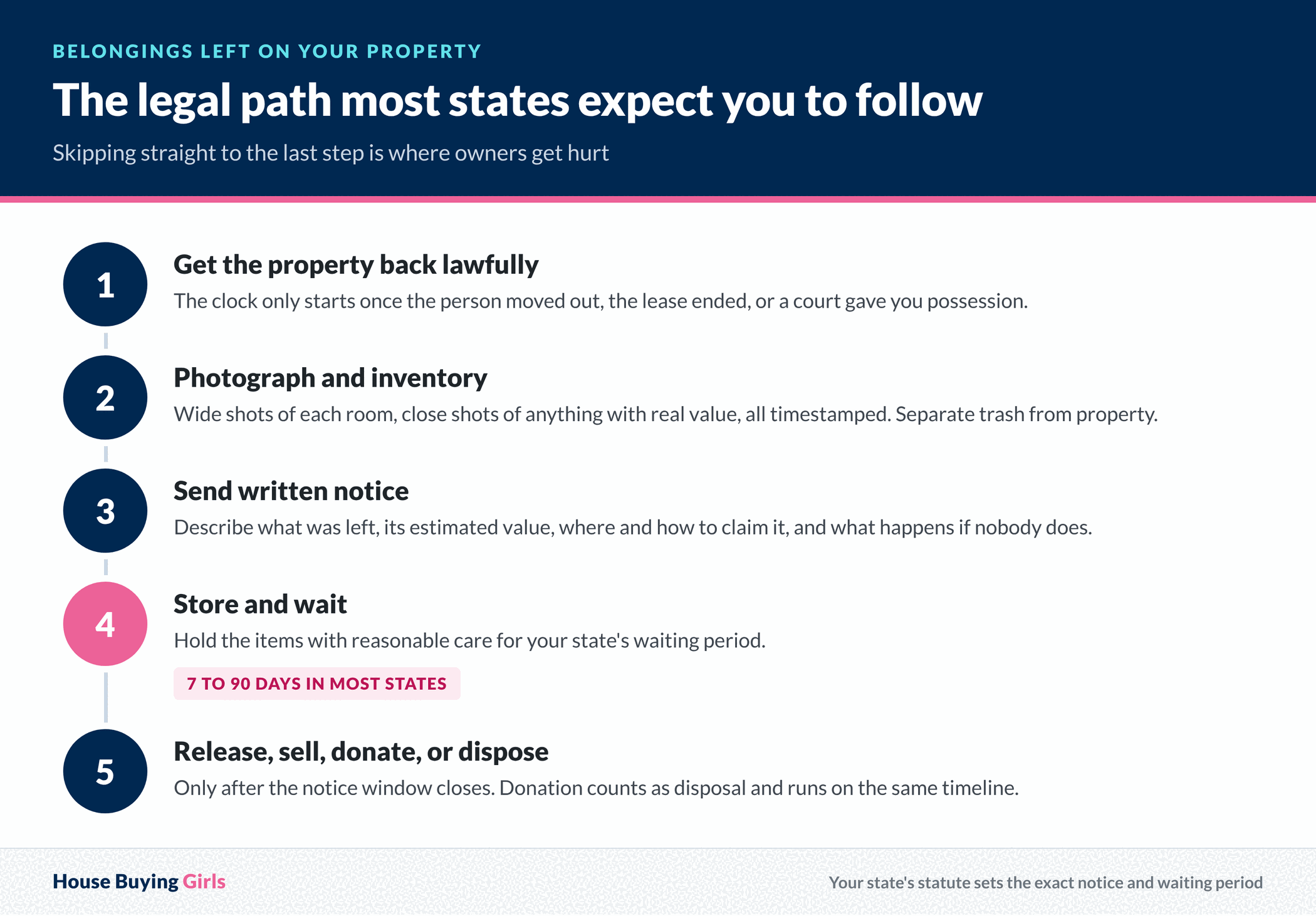
Abandonment is a legal conclusion, not a feeling. In nearly every state, items left behind after a tenancy are presumptively abandoned. This is a different thing from automatically being yours to throw away. So the law typically routes you through a short path: confirm the abandonment, give written notice, hold the items for a set period, then dispose of, donate, or sell them. Skipping to the last step is where people get hurt.
So what separates trash from belongings on property worth protecting? Courts sorting belongings on property generally look at apparent value, not sentimental value. Half-eaten food in a refrigerator is garbage. A toolbox is not. A box of loose photographs sits in a gray zone, and I’d rather photograph it and box it than argue about it later.
Occupancy status drives the whole analysis of belongings on property. You can only handle someone’s belongings after you legally have the unit back, meaning they moved out, the lease ended, or a court gave you possession. A tenant who still has keys and a legal right to be there hasn’t abandoned anything, no matter how long the pile has been sitting.
Many of those situations get handled under general property or bailment law instead, and some states leave the question largely to the courts.
What Does the Law Say About Belongings Left on Your Property
“Can I just call it abandoned and be done?”
I get asked that constantly, and the answer is governed entirely by your state. A written Notice of Abandonment and a waiting period that runs anywhere from 7 to 90 days are required in most states, so where the property sits makes all the difference. A landlord in one state can act inside two weeks; a landlord three states over waits three months for identical facts.
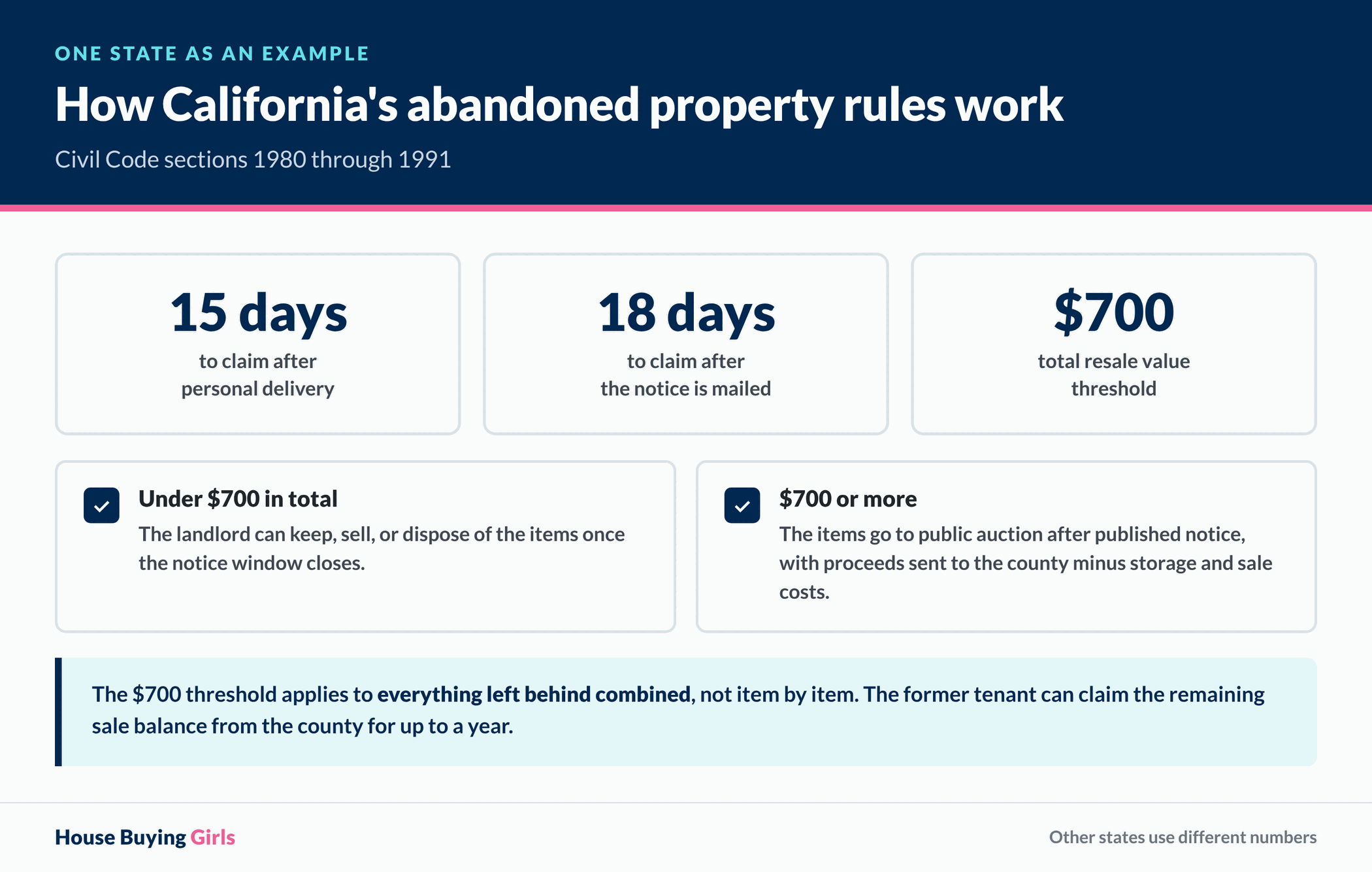
California’s statutes illustrate in detail how specific these laws get. Civil Code sections 1980 through 1991 require written notice of the right to reclaim the items, describing what was left and where it can be picked up. The former occupant gets at least 15 days after personal delivery or 18 days after mailing to claim it. What happens next comes down to value. If the landlord reasonably believes everything left behind has a total resale value under $700, it can be kept, sold, or disposed of once the notice window closes. But at $700 or more it must go to public auction after published notice, with proceeds handed to the county minus storage and sale costs. The threshold applies to the total, not item by item.
Some states barely address belongings on property at all. Georgia and New York, for instance, have no fixed statutory holding period, so lease language and documentation carry more weight there. You can read your own state’s statute through your state legislature’s website, or Nolo’s overview of abandoned tenant property gives a plain-English starting point before you call a local attorney.
How Long Can Someone Leave Their Belongings on Your Property Before It’s a Problem
Toss a former occupant’s possessions a few days early and you can end up owing them the full value of everything you threw out, plus whatever damages your state tacks on. Disposing of items without running the required process exposes you to liability for the property’s value, and doing it while the tenant still has possession can amount to an illegal eviction. The dollars rarely stay small.
U.S. home prices in October 2026 came in at a median of $388,634, down slightly from a year earlier, with homes taking a median 50 days on the market. Every week a garage full of someone else’s possessions sits there is a week you’re not listing, not renting, not closing.
A while back I worked with two adult children in Arlington, Texas, whose mother had moved out of her 1950s ranch and into their spare room. Their contractor priced out the kitchen at more than the kitchen would ever add to the house, and the detached garage still held their father’s woodworking equipment that nobody could bring themselves to sort. We bought it as it stood, tools and all, on a Thursday walkthrough that took twenty minutes.
One distinction matters most for belongings on property: the clock that counts isn’t the one that started when the person stopped living there. It starts when you lawfully regain possession and serve proper notice. Five months of a sofa sitting untouched does not shorten a statutory 30-day window by a single day.
Insurance carriers get twitchy about vacant structures. Property taxes don’t care who owns the sectional.
How to Notify Someone About Belongings Left on Your Property
Your notice about belongings on property isn’t for them. It’s your evidence.
A proper notice generally spells out a detailed description of what was left behind, the estimated value, where and how the person can claim it, and what happens if they don’t. It should stay short and factual with no editorializing about how inconsiderate the whole thing is.
Send a regular first-class copy too. Certified mail gets refused or sits unclaimed at the post office constantly, and a plain copy is harder to argue about later.
How long does the recipient get to respond? Most states require the notice to list a claim deadline, commonly in the range of 7 to 10 days. Your state’s number controls and some run far longer, so don’t pick a date out of the air.
Surprise fees invented after the fact tend to get thrown out.
For heirs and estates, the notice usually has to reach whoever legally stands in for the deceased rather than the deceased person. Oregon’s statute, for example, directs the notice to the heir, devisee, personal representative, or designated person instead of the deceased tenant, and you can read the text at Oregon’s public statute library. Other states handle it differently, so confirm yours before addressing an envelope to a probate estate.
Steps to Take When Someone Leaves Their Belongings Behind
Step one is always photographs. Wide shots of each room, then close shots of anything with real value, all timestamped. The camera in your pocket builds a better record than any inventory sheet you’ll type up afterward.
Then separate the belongings on property into categories. Divide trash from property, inventory what’s left, send the notice your state requires, store the items with reasonable care, and release them once the claim requirements are met. That sequence is the whole job, and the hard part is resisting the urge to compress it.
A few categories get special treatment, and it’s easy to miss which ones. Wisconsin, for one, generally lets a landlord dispose of items left behind. But prescription medication and prescription medical equipment must be held seven days from when the landlord finds them. These must be returned promptly if the tenant asks before disposal. Firearms, vehicles with titles, and pets come with their own rules in many places.
Post-eviction situations follow a different track than voluntary move-outs because property left after a sheriff or marshal executes a writ of possession often falls under a separate, shorter procedure. Some states let you treat it as abandoned after brief notice while others still require storage. Ask the deputy who executes the writ what happens at the curb in your county.
Can You Throw Away Belongings Left on Your Property
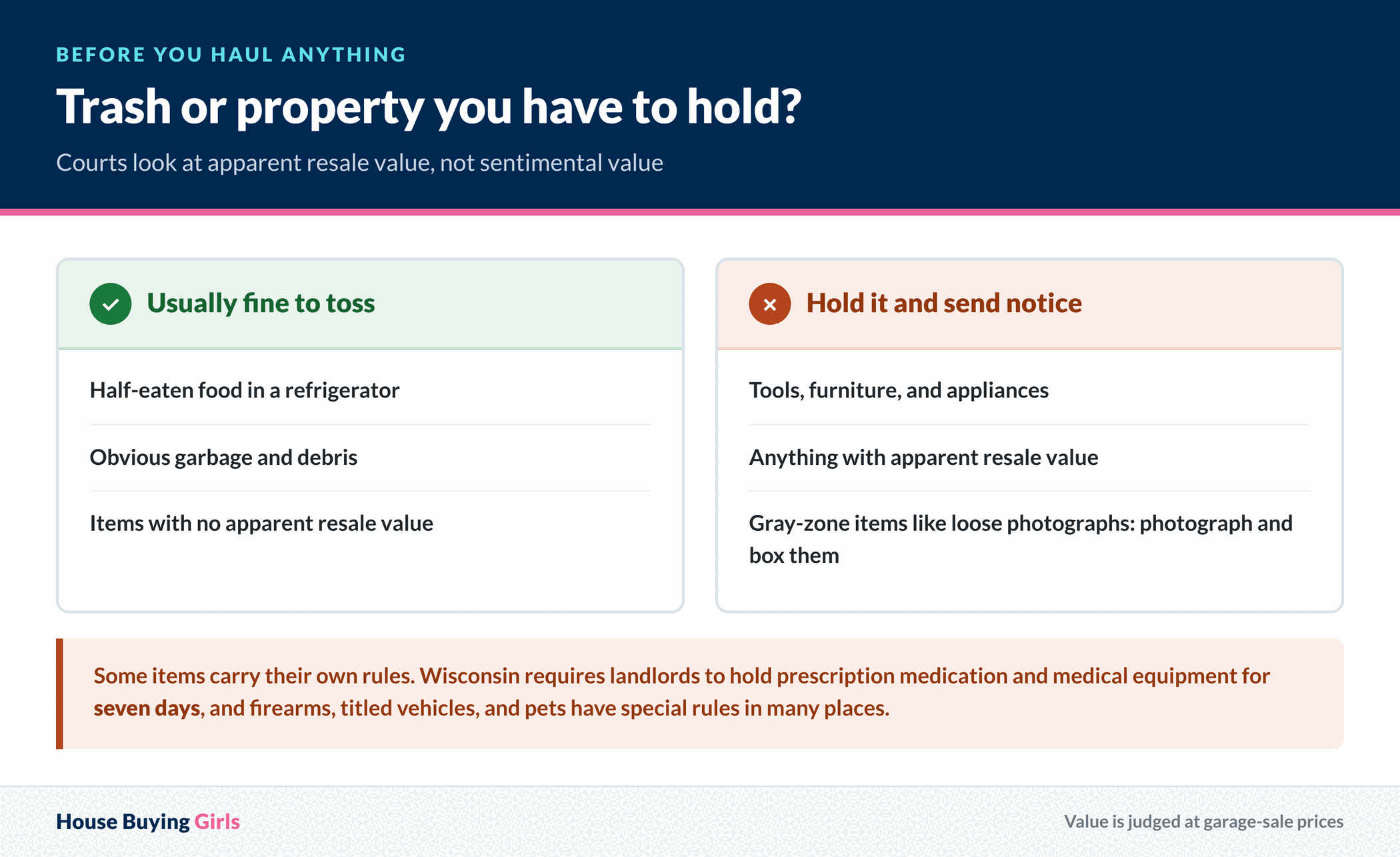
Value is judged at garage-sale prices, not replacement cost. The standard is what a reasonable person thinks the items would sell for secondhand, not what they’d cost to buy new. That single distinction changes the answer in a lot of houses I’ve walked through. A living room that cost $8,000 to furnish might be worth a few hundred dollars on a driveway on a Saturday.
Belongings on property with apparent resale value are different. Property with apparent value can’t be discarded until your state’s notice has been served and its waiting period has expired. The waiting period is the whole protection, and it runs on the calendar, not on your patience.
Most states treat donation as a form of disposal, so it gets governed by the same timeline as the dumpster. Hauling a dead tenant’s furniture to a charity thrift store before the window closes is just as actionable as trashing it, even though it feels generous. The law looks at whether the owner lost the chance to reclaim it, not at where the sofa ended up.
Sale proceeds usually aren’t yours to pocket, either. After a required public sale in California, the landlord deducts storage, advertising, and sale costs, and the former tenant can claim the remaining balance from the county for up to a year. Other states route surplus funds differently; your county clerk’s office can tell you where the money goes locally.
What Happens If You Remove Belongings on Property Too Soon
“They abandoned it, so how could they possibly sue me?” Because abandonment, again, is something a statute decides, not something an absent occupant announces by leaving. A judge doesn’t care that they ghosted you for four months if your notice went out two days before you rented the dumpster.
Damages in cases over belongings on property follow the items’ value, and the valuation argument rarely goes the defendant’s way. Under California law, if a landlord fails to send proper notice or disposes of property before the notice period expires, the tenant can sue for the property’s fair value plus additional damages. Many states layer on statutory penalties beyond the replacement cost.
Acting early is precisely what creates the liability. Your photographs are the only defense that holds up, and you can’t take them after the fact.
You carry separate exposure attempting self-help removal when someone still occupies the place. In California, pulling belongings out to end an occupancy, outside the statutory procedure, violates Civil Code section 789.3, and most states have an equivalent, often with attorney’s fees attached.
How to Protect Yourself From Disputes Over Belongings on Property
I used to think a signed move-out form settled the question of belongings on property for good. It doesn’t, not when the form is vague about what was actually left and nobody wrote down what “miscellaneous items” meant.
Specificity in writing is the whole defense. List items by category and quantity. “Three bedroom sets, one washer, one dryer, eleven boxes in the basement” beats “personal property” every time somebody’s memory gets creative eight months later.
Sellers rely on lease language, especially in states that never wrote a holding period into statute. A clause spelling out how long you’ll store items, what storage costs, and how notice gets delivered gives a judge something concrete to enforce. In places like Georgia and New York, it’s the documentation and lease terms doing the work the statute isn’t.
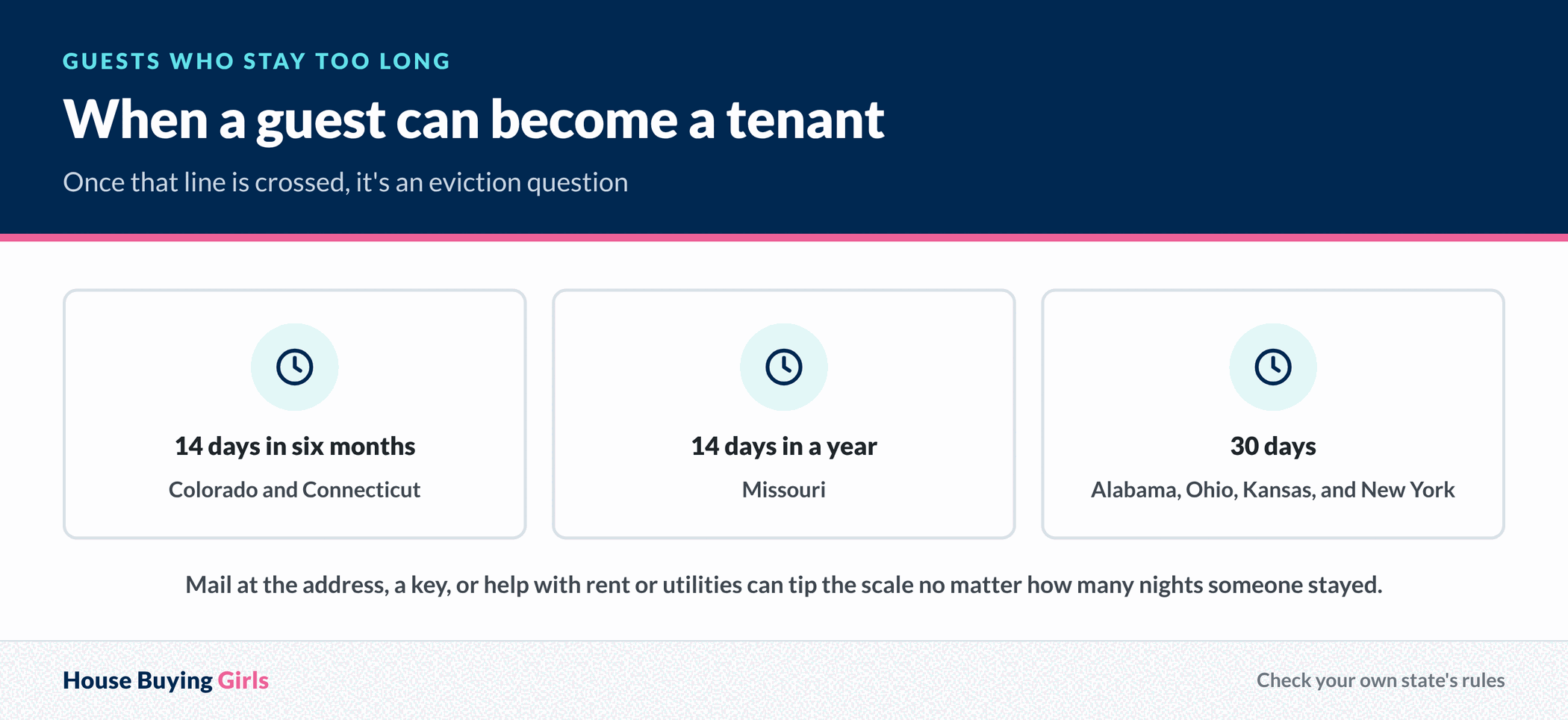
Guest situations deserve their own paragraph, because that’s where owners get blindsided. Several states set explicit cutoffs. Colorado and Connecticut treat a guest as a tenant after 14 days within six months. Missouri uses 14 days within a year, and Alabama, Ohio, Kansas, and New York use 30 days. Once someone crosses that line, their belongings on property stop being a cleanup question and become an eviction question. You can check your state’s position through iPropertyManagement’s guest rights summary and verify it with a local attorney.
I’ve never once regretted over-documenting, and I’ve watched owners regret the opposite plenty.
A landlord in Plano, Texas, reached out as her father settled into assisted living two hours away. Her rental’s former tenant had left a motorcycle, a workbench, and roughly forty gallons of old paint in the garage. She was spending her Saturdays driving between two obligations with no time for a third. She handled the notice properly, waited out the window, and then sold the house with the workbench still bolted to the wall. Sometimes the right move is doing the legal part correctly and letting a buyer absorb the rest.
Selling as-is is a legitimate answer when the cleanup math stops working. A local buyer like House Buying Girls can take a property with contents still in it, which removes the hauling question entirely. That only works after the legal holding period has run, though. No buyer can waive a former occupant’s statutory rights for you.
Frequently Asked Questions
At What Point Does a Long-term Guest Turn Into a Legal Tenant?
It depends on your state, and the thresholds genuinely range from about two weeks to a month, with some states tying it to behavior instead of a day count. Receiving mail at the address, having a key, or contributing toward rent or utilities can tip the scale regardless of how many nights someone has stayed. Once that line is crossed, you can’t just change the locks; you’d have to go through a formal eviction. Writing a guest limit into your lease is the cheapest protection available.
What If a Former Occupant Says You’re Keeping Their Things From Them?
Answer their request in writing, sent certified, and offer specific times for pickup. If tension runs high, most areas let either side ask local law enforcement for a civil standby, where an officer keeps the peace while the belongings on property change hands. When the value is high enough, small claims court handles these disputes without a lawyer in most states. Courts generally take a dim view of anyone holding another person’s possessions hostage over a dispute.
Does a Storage Fee Have to Be Paid Before Someone Can Pick Up Their Belongings on Property?
In many states, yes, as long as the charge is reasonable and you disclosed it in the notice you sent. You can’t invent a number after the person shows up at the door. Some states cap what you may collect or bar fees entirely, so check your statute before you quote a figure.
Do These Rules Change If the Person Who Left the Items Passed Away?
They do, and belongings on property left by someone who died follow different steps. The notice typically has to go to the estate’s representative or the heirs rather than to the person who died, and probate may control what happens to anything of real value. Reaching out to the probate court in the county where the person lived is usually the fastest way to learn who has legal authority to claim the items.
If you’re staring at a house full of someone else’s things and trying to figure out whether it’s worth the cleanup, we’re glad to talk it through. We’ll tell you straight whether listing or selling as-is makes more sense for your situation, even if the answer means you don’t need us. No pressure, no obligation, and no cost for the conversation.
Left-Behind Belongings and Selling in Dallas
Dallas owners feel this squeeze too. Redfin put the city’s median sale price at $448,703 for the three months ending August 2026. Every month a house sits full of someone else’s things is another month of taxes, insurance and utilities.
Once the legal holding period has run, you don’t have to haul it all yourself. Our page for cash home buyers in Dallas explains how we buy houses as-is, contents and all. We also buy houses in Arlington and across the metro.
Talk With Us About a House Full of Someone Else’s Things
You don’t need to sort every box before you call. Tell us about the property and what’s still inside, and we’ll walk through your options with you. When you’re ready, reach out to House Buying Girls or fill out the form below.